JMT's Nonprofit World Blog

Top 100 Logo

At JMT we are proud to once again be distinguished as one of the leading providers of ERP software to the mid-market by Bob Scott. What distinguishes JMT on this list is that we are the largest firm that exclusively serves the not-for-profit space.  Our focus on nonprofits and the quality of the projects that we deliver are reflected in our inclusion on this list.  We are grateful for the trust that so many organizations have placed in us and we look forward to continuing to grow and serve this sector for many years to come. 

Click here for for full press release.


sage

Among the many advantages of using the top-rated fund accounting solution in terms of user satisfaction is the fact that just about everything in the software just works.  Unexpected error messages and bugs are rare.  The features are mature, intuitive and designed around how nonprofit and local government agencies do accounting.  Considering these factors, many users may feel content that things are going well and just go about their business without exploring ways to get better connected to the community of over 6,000 organizations that use MIP.

Even if you feel like you have a pretty good grip on how the applications work, it is very likely that there are dozens if not hundreds of features, capabilities, techniques, approaches and other valuable things that can be increasing the value of the system you have already paid for that you simply haven’t found.

One of the best and most cost-effective ways to start whittling away at this list is to join your local user community.  Here are five reasons why doing so is a smart choice for your finance team:

  • Professional Networking – Meeting other professionals in your area that share some of the same day-to-day challenges provides a support system both as it relates to your MIP system and more broadly as a finance professional
  • Direct Access to Experienced Consultants – Some things are easy to figure out on your own.  Others get learned the hard way.  Our road-tested consulting team facilitates these meetings and are available to help answer questions and solve problems during the meeting
  • Best Practices – By definition, best practices are developed collectively through the experience of a broad group of people seeking to accomplish the same ends.  The educational content in these meetings provides an opportunity for you to incorporate these best practices in your day-to-day use of the MIP system.
  • Exposure to Options – Few organizations are fully-automated in their finance function.  You may still do some reporting offline in spreadsheets.  You may have a legacy system for managing procurement.  Regardless of the specifics of your situation, user group meetings are great venue to learn how other organizations manage these processes and learn about products in the marketplace that can make your team more efficient.
  • Provide Candid Feedback – User Group meetings are a venue where your ideas and suggestions for improving MIP can be shared, clarified and documented for presentation to the publisher.  JMT’s consultants work with users to make sure that the ideas are clear and complete and communicated to the designers of MIP promptly after each meeting.

Besides these things, it’s also worth noting that there are usually bagels and coffee served at no cost.  I realize not everyone who uses MIP lives in a geography that can support a local users group, but for those of you that do, I strongly encourage you to check it out.

If you haven’t heard about a User Group in your area, feel free to contact JMT (cam@jmtconsulting.com) about introducing one.  In the meantime, we strongly encourage all MIP users to participate in JMT’s regional events as well as the MIP User Conference that is scheduled for November in Austin, TX.

serverThat’s the question we asked ourselves at JMT a few years ago when we were deciding whether that next big investment in servers and other infrastructure upgrades was the right path.  For many businesses and nonprofits, costs related to IT infrastructure, personnel, outside services and all of the other expenses necessary to keep your critical applications running can push as high as 20% of the annual operating budget.  Even if you accept these costs as the “cost of doing business”, it is still disruptive, both financially and to productivity, when the inevitable spikes in cost hit that are outside of your plan.

At JMT, we made the decision to take all of our critical business applications to the Cloud a few years ago.  It didn’t happen overnight.  First and foremost, we didn’t want to sacrifice any essential capability that would impact our ability to operate at a high level.  This meant carefully vetting applications based on their ability to serve JMT’s needs.  Secondly, we needed to understand the relative total cost of ownership of these systems compared to what we had in place.

JMT, like many organizations, had existing infrastructure (mail, database servers, Citrix, etc.), perpetual licenses to the software we used (we paid publisher support and maintenance), staff who were either full or part time dedicated to performing IT work, outside IT consulting contracts and the works.  Comparing the cost required that we look out over a longer period of time to recognize the licensing differences between SaaS applications and what we were used to as well as looking ahead to a time where we wouldn’t need servers and other infrastructure on which to host these applications.

We started with CRM and were able to use a cloud-native CRM side-by-side with our on premises accounting and productivity applications.  Soon thereafter, we moved away from Microsoft Exchange and began using Google Apps for e-mail and collaboration.  The next big piece after that was to move to a cloud-native financial management solution that could be fully and seamlessly integrated with our CRM.  The final piece, which is wrapping up right now, is to move all file storage/management offsite leaving just one box in our office to manage local connectivity and broadband access for the computers in our main office.  The rest of everything we do is securely managed in the Cloud.

We are now converting what used to be our server room into additional office space.  Our staff is able to work as productively from the office or at home or from a hotel without any additional enabling technologies.  Our company is saving tens of thousands of dollars a year in expenses related to upgrades, hardware, outside services and other things we didn’t ever think twice about paying in the past.  These savings weren’t immediate, but they became apparent once our transition was complete.

weighing options (cropped)When considering a professional consulting resource for a back office systems project (accounting, donor management, HR, etc.), many people immediately assume that they want to find someone local who can complete the project.  The superficial reasons are obvious – why would I want to potentially pay travel costs any time I need to have a resource on site for consulting, training or otherwise?  A local resource won’t charge me to drive across town for an engagement, but the firm from out of state definitely will.  A “no brainer”, right?

Maybe not.  In over 20 years of project work, we have unfortunately seen many organizations base their selection of their partner for mission critical IT projects based solely on proximity to their location.  While this makes sense when you are comparing two alternatives that are exactly equal in every other respect, but in real life that is never the case.

Travel cost and potential future availability to provide timely on-site support should both be factors in your decision whether to work with a partner on mission-critical projects.  However, those factors should not blind you to other factors that deserve equal or greater weight in your selection process.  As a nonprofit considering spending a substantial amount of money on a project (let’s assume over $20k), there are much more important considerations than a couple of thousand dollars in estimated travel fees.

Here are three things that we recommend that you weigh more heavily than “local presence” when comparing options:

  • Experience – Can your provider demonstrate past success through verifiable references from similar projects?  How many projects?  How many years has the organization been in business doing this particular type of project?
  • Industry Knowledge – Does your provider understand the nonprofit space and the unique requirements of organizations in this sector?  Is nonprofit their focus or only a small part of their business?  Do they speak the language?
  • Scale – Is the organization large and diverse enough to bring all of the necessary skills and competencies to the table that your project requires?  Does the organization have a deep bench to ensure coverage in the case of turnover or other disruptions?  Do they have the ability to grow with you in the event that you experience explosive growth?

One of the most important expectations you should have about your consulting partner on this type of project is that they will help you manage risk.  Converting to a new critical business system is an inherently risky, potentially disastrous endeavor by its very nature.  Favoring local presence over experience, industry knowledge and scale potentially puts your organization at risk of never achieving the Point B you have defined.  Do your due diligence

To be fair, there are cases where proximity is a definite advantage.  For instance, if your organization has significant local compliance requirements that people from outside of your locality couldn’t possibly be familiar with, it should be a bigger factor.  Also, local presence can be viewed as an excellent tie-breaker in the event that you identify two consultants with roughly similar characteristics to support your project.

In any case, if you have a local partner that meets your needs in terms of the three factors listed above, then it truly is a “no brainer”.  At JMT we have hundreds of clients to whom we are a local resource.  However, we work tirelessly to ensure that they choose to work with us because of our ability, not our location.

Clock

How much is that?  Are you sure?

Consultants, CPAs, attorneys and other professionals have long relied on time & materials billing as a cornerstone of project costing.  When a client approaches with a problem, they estimate the number of hours they will likely need to complete the work and then multiply that by the hourly rate they charge for that type of work.  So if they think the client’s project will take 100 hours and their hourly rate is $150/hour, they can quote $15K for the work “give or take”.  Some may even provide a low, likely and high estimate to allow for the fact that the client will be billed based on the actual number of hours it takes, regardless of what was originally quoted. 

Tragically, an estimate is an estimate and, in many cases, the total effort necessary to complete the work exceeds what was originally envisioned.  This can occur for a number of reasons, but common reasons are insufficient scoping or inefficient execution.  This sometimes results in open-ended engagements where the consultant continues to bill the organization long after the original budget is consumed.  This is bad for both the organization and the consultant who must justify why the original estimate was so far off.  At the end of the day, the time & materials billing paradigm leaves the client holding the bag and eating the difference. 

In our work with nonprofit organizations, we have found that two important factors most often result in a successfully, on-budget project:

  • Comprehensive Discovery & Scoping – Perform detailed discovery and scoping prior to beginning the project.  If you know exactly what Point B looks like and you have a clear roadmap for getting there, it’s less likely that you will see constant shifts and changes throughout the project. 
  • Guaranteed, Fixed-Price Engagements – Instead of estimating the effort necessary to complete the project, agree to a fair price for the finished product.  If a successful project is worth $X, agree to $X instead of gambling on the unknown of how many hours it will actually take your consultant to do the work.

There are many advantages to this approach beyond what has already been stated.  Eliminating the uncertainty about the cost is something every nonprofit can appreciate.  Avoiding any risk of having to go back to the board of directors to authorize more money for the project than was originally anticipated is highly desirable. 

Some final thoughts to keep in mind:

  • Keeping, monitoring, questioning and signing off on timesheets is an inefficient hassle for both you and your consultant.  If you take that out of the equation, greater focus can be placed on completing the scope of work.
  • You can’t establish a fair price without doing sufficient discovery on the front end.  If someone offers you a fixed price, but hasn’t asked many questions to scope the project, read the scope carefully and be ready for change orders. 
  • Some providers will, with good intentions, provide a low hours estimate of the effort necessary to try to keep the price down in cases where there are strict budget constraints.  This can be a recipe for disaster since the effort necessary to achieve point B doesn’t change based on good intentions.  You end up with either incomplete work, or paying more.

Remember, in a time & materials billing situation, it is the consultant that is protected from risk.  If you get a well-scoped, reasonably priced fixed-price engagement, you are the one who is protected.  


increased quality - speed - efficiencyAs a nonprofit, comparing a subscription-based (SaaS) cloud application for finance or donor management to similar traditional installed client/server application can be confusing.  It is easy, but misleading, to focus on licensing alone as the basis of comparison.  In fact, this is not an apples-to-apples comparison since many of the costs associated with applications installed and deployed on your local network infrastructure are hidden and not typically acknowledged as part of the total cost of the solution. 

In fact, I have heard more than one prospective client express confusion and concern about the ongoing costs of a SaaS subscription, but in the same breath dismiss the costs of servers, upgrades, remote access and other infrastructure as unavoidable.  This is easy to do if your organizational structure has those IT costs buried in an administrative budget and allocated to departments in an opaque fashion.

This kind of comparison wasn’t necessary in the past when all of the solutions being considered employed similar technology platforms and were going to be deployed in roughly the same fashion.  Back then, the only considerations were subtle differences in system requirements and pricing.  The reality is that the infrastructure and maintenance cost of traditional applications is relevant and should be factored fairly into your total cost of ownership calculation when including cloud-based applications. 

Things to keep in mind as you work through your evaluation:

  • Infrastructure isn’t free, even if it’s already there – Servers require maintenance, patches, upgrades, software and replacement.  Factoring a fairly allocated cost for the infrastructure required to deploy an on premises application is appropriate. 
  • Secure Remote Access – If remote access is required either for distributed offices or for flexible work arrangements, most traditional applications require things like web servers, VPN, Citrix and potentially other advanced networking tools, not to mention competent IT support, to be able to do so securely.  It’s assumed that in a true cloud-based SaaS environment that these costs are built into the subscription and you will enjoy secure access from anywhere at any time with no incremental cost.
  • Fit matters – No two applications address your organization’s critical business requirements exactly the same way.  No organization should choose or disqualify a cloud application just because it is a cloud application.  Capability and compatibility with your organization’s unique requirements and goals should be an overriding concern and factor into your comparison of any two systems, regardless of technology or business model.
  • The Future Matters – Sometimes the most feature-rich, capable application is also the one built on the most archaic technology platform.  If a capable system has passed its prime, technology-wise, you should expect to be subjected to a major, disruptive upgrade at some point in the future or slowly watch that application lose relevance as the march of technology pushes forward.  The viability of the technology in question both today and where the world it is likely to be in 7 years is an important consideration.

JMT has worked with a number of organizations in the very recent past where their unique circumstances made going with the cloud-based application a complete no-brainer, even though the nominal subscription costs seemed higher than traditional, locally installed alternatives over time.  In that same timeframe, we have matched organizations with those same traditional, locally installed applications because that it what made sense for that particular organization given their unique circumstances.  The important point in post is that you should not dismiss either option out of hand, but employ a fair, systematic approach to evaluating your options so that you can make an informed, deliberate decision.

Congratulations (cropped)

Last month we all were given the official news that Sage Nonprofit Solutions was being sold to Accel-KKR, a private equity firm.  This week, that sale was finalized and Sage Nonprofit Solutions is legally an independent company, no longer a part of Sage North America.  Congratulations to our colleagues at the new company!

As we noted a couple of weeks ago, there are a quite a few advantages to this new ownership configuration for users of Sage 100 Fund Accounting, Sage Fundraising 50, Sage Fundraising Online, Millennium and the other products that are part of the Nonprofit Solutions family.  Most importantly, the organization will be able to be singularly focused on delivering value for the nonprofit and local government clients it has served for over 30 years (through previous ownership transitions).  Look for a new brand to emerge that emphasizes this exclusive connection to the nonprofit and public sectors.

Here are a few things that we have learned that are worthy of noting:

  • As of today, a new company name and brand have not been finalized.  This is expected to come together in coming weeks.  Be on the lookout for communications announcing the new company name.  JMT is contributing input to Nonprofit Solutions and their agency to help formulate this new brand strategy.
  • Since “Sage” is integrated into all of the product names as part of Sage North America’s master branding strategy, you can expect all of the product names to change to varying degrees.  One change that has been informally confirmed is that Sage 100 Fund Accounting will be renamed and include the traditional brand name “MIP” in some way.  This is good news for those of us who could never stop calling it MIP anyway.
  • Over time, you can expect updates to your software to include changes to remove references to the Sage brand.  Further, some of the features that were motivated by common Sage initiatives may be deemphasized or phased out over time.
  • Krista Endsley, previously SVP & GM of Sage Nonprofit Solutions, is continuing as CEO of the new company and will be guiding the company during the transition and onward through its aggressive growth strategy.  Further, all key members of the Nonprofit Solutions management team are remaining in place at the new company.  This means that you can continue to expect the consistent, high quality execution that you have grown to expect in all phases of the business.
  • Nonprofit Solutions, as an independent company, is in the process of transitioning systems (finance, CRM, etc.) away from the shared Sage infrastructure to systems of their own.  This is being done carefully, but it would be prudent to expect some bumps in the road as this occurs.  If, at any time, you encounter something strange or are struggling reaching the appropriate point of contact at Nonprofit Solutions for any issue, please contact your JMT CAM.

JMT Consulting Group, as Nonprofit Solutions’ largest business partner, is working very closely with our colleagues at the new company and will continue to share information as it becomes available.  We will continue to update you on the status of the transition through this blog and encourage you to contact us at any time if you have any questions or concerns about the transition.

RFP - tips1

Many large (and some small) nonprofit organizations and most state and local government agencies have formalized procurement policies that require the use of an arm’s length, competitive bidding process for purchases over a particular amount, also known as a Request for Proposals (RFP).  Regardless of the rationale for the policy or the desired outcome, poorly executed RFPs cost their issuers considerably in the form of time, project cost and opportunity cost.  RFPs can work well for getting competitive bids for commodities, but can be problematic when procuring unique, customized products and services.  If you know what you want and are simply looking for a low bidder for identical products/services, an RFP can work well.

If you are in position where you are either considering or compelled to use an RFP as part of your procurement of a new application software solution (finance, CRM, HR, etc.), we recommend keeping the following in mind:

  1. Research first.  Don’t use the RFP as a means for gathering requirements and market information.  If you are unsure of “what’s out there”, go look.  Engage help.  Do internal business analysis to clearly understand your own processes and why you have them.  Once you have done the necessary information gathering, sharing clear requirements with potential vendor partners will be a lot easier and provide better results.
  2. Be clear about what Point B looks like.  Don’t ask for a laundry list of features or capabilities in no particular order.  Describe your utopian vision for where your organization will be once the project is complete.  This means clearly describing your current situation and the rationale for the project.  It also means describing and prioritizing the capabilities that you believe are most relevant to project success.  By its very nature, the RFP process limits the amount of discovery a potential vendor can perform, so don’t make them guess.
  3. Share your project budget.  Yes, give vendors a ballpark of what your organization is willing to spend so vendors that can’t deliver an appropriate solution in that price range disqualify themselves and save both of you time and money.
  4. Avoid complex “scoring” models.  Some organizations employ vendor solution scoring as a means of enforcing “objectivity” on the process.  While these are created with good intentions, the models themselves can be flawed and yield results that are completely different than the intuition of the majority of the selection team.  This is especially true if those scores are applied primarily to application features and functionality.  Further, it can result in disqualification of the best solution based on what amounts to an unintended “technicality”.
  5. “Who” matters.  In projects where a material portion of the project budget is services, give appropriate weight to the qualities of the vendor and don’t understate the importance of execution to the overall success of the project.  Two implementation partners with arguably similar technical solutions and prices will only be differentiated by their organizational qualities:  vertical expertise, experience in similar projects, references, business philosophy, project methodology and culture.

I wish I had room in this blog post to share some of the more ridiculous anecdotes and examples from RFPs we have received in the past (“accounting software must be able to print checks”, “score this list of >3,500 un-prioritized features on a scale of 1-5”).  Suffice it to say we have refused to compete for projects where we may have been the ideal solution provider for the organization in question, but chose to stay out because of the absurdity of the process itself.

Here are some things to keep in mind as you compose your next RFP:

  • Vendors weigh the cost of responding against their perceived probability of winning the business.  The smartest solution providers will avoid responding in cases where the cost to respond is too high or the probability of winning the business is difficult to determine.
  • Hiding your decision criteria (i.e. your priorities and budget) from the vendors hurts you.  Vendors will not have a clear understanding of how to respond or will unintentionally omit relevant information from their proposal.
  • RFPs very often result in a purchase decision being made based on incomplete information.  This is a natural byproduct of the restricted communication flow common to the procurement process.

RFPs will continue to be a fact of life for many agencies.  JMT recommends that those agencies that are required to use this procurement form follow the advice offered above and, if possible, avoid use of RFPs whenever possible.

Why is everything so hard?

Reconfigure (Cropped)

Things used to be great.  The data entry made sense.  The reports were all configured to give us exactly what we needed.  Month end processes were efficient, routine and predictable.   Now it seems like we’re doing more and more offline in Excel spreadsheets.  Coding is confusing.  Month end is painfully inefficient and reporting is time consuming compared to before.

What happened?

When you make a substantial investment of resources in a new financial management system, you have a justifiable expectation that the technology and tools will continue to provide benefits for years to come.  For some organizations that are on a relatively stable vector, this works out.  However, for many organizations, circumstances create a material shift in the assumptions underlying the design of the finance system.

There are a lot of things that can disrupt the effectiveness of your current system design:

  • Introduction of substantially more or different sources of funding
  • Substantial growth or contraction in operating revenues
  • Functional reorganization
  • Mergers with similar organizations
  • Introduction of substantially different programs or services
  • Key personnel turnover

Besides these factors, the march of time also introduces external pressures on the organization such as new regulatory requirements, technology shifts and new funder reporting expectations.

A common logical pitfall is to assume that the software in place is no longer the right fit for your organization’s requirements.  While this is sometimes true, most of the time it is not.  In order to realize the full potential of the tools at your disposal, it is essential to periodically reevaluate how you have deployed the system including:

  • Is the Chart of Accounts design optimized for your ideal operational and financial reporting structure?
  • Are you fully utilizing the applications and components that make up your current system?
  • Are there optional applications or 3rd party tools available that could materially improve your financial management effectiveness?
  • Is the finance system working well and seamlessly in the context of the entire back office application environment?
  • Is your team properly trained to take advantage of what you have?

JMT recommends that all organizations reevaluate their financial system at least every 3-4 years to ensure that the system is, in fact, optimized in the context of the unique requirements and business processes of the organization.  We routinely help our clients through this process and what most have found is that it has breathed new life into their systems without having to go through the cost and painful process of evaluating and converting to another system unnecessarily.

Silverware in a pocketThis month we are proud to feature JMT’s Executive Seminar Series topic “A CFO’s Guide to Evaluating Nonprofit Financial Systems”. 

At JMT, we are dedicated to helping our nonprofit clients advance their mission through optimized systems and processes.  In some cases this involves identifying appropriate financial management software if the systems you have in place are not adequate.  Given that most nonprofit organizations tend to keep the same accounting software in place for seven years or longer, getting educated and making an informed, deliberate decision on new software may seem daunting.

Recognizing this, JMT is offering a live Executive Seminar series in cities across the country this month (March 26-28).  Over a free gourmet lunch, our consultants will help CFO’s and other senior finance staff to understand key issues related to nonprofit financial software evaluation including:

  • Distinguishing features from requirements and priorities
  • Establishing a credible financial rationale for the project
  • Factors to consider when comparing potential solutions
  • The technology landscape, including the Cloud, hosting and other infrastructure factors

As part of this seminar, we will be comparing the merits of two widely-used financial management systems, Intacct and Sage 100 Fund Accounting (MIP), to illustrate the issues discussed above. 

Whether you have an immediate need or are looking ahead to a project in 2014 or beyond, you can expect to walk way better equipped to manage a successful transition for your organization.


Why Best-of-Breed Works for Nonprofits

Why Best-of-Breed Works for Nonprofits For years it seemed like the Sophie’s Choice facing every nonprofit manager was whether to go with a single vendor for all of their business applications (accounting, fundraising, HR, etc.) or source them independently and sacrifice meaningful integration.  The story went that if you didn’t buy from a single vendor, [...]

Software vs. Solution

Why work with an independent value-added reseller versus a software publisher directly? If you have ever approached a software vendor about their product, it probably went something like this:   “Do you have budget for a purchase?” “When do you plan to buy?” “Are you the decision maker?” “Who is our competition?”  “Have you seen a [...]

Independence from Sage for Sage Nonprofit Solutions

Last week the news broke that Sage Group PLC, the UK-based company that owns Sage North America and many software brands worldwide, was planning to sell Sage Nonprofit Solutions along with a number of other products as part of its stated goal to become more focused on their core business.  This news was not surprising [...]

What is Nonprofit Accounting Software?

I spoke recently with a prospective client that asked a simple question:  What makes nonprofit accounting software “nonprofit accounting software”?  I realized at that moment that there are software products in the marketplace that bill themselves as being “built for nonprofits” and there are others that claim to “work well for nonprofits”, but then the [...]

Why A Table-Driven Chart of Accounts Matters

When implementing a financial accounting and reporting system at a nonprofit organization, few would disagree that an optimized Chart of Accounts design is critical to success. Being able to produce accurate compliance reports and meaningful management reports is the point of the exercise. Failing to get it right can add substantially to the workload and [...]

Technology = Investment in Mission

A recent article in Philanthropy Journal featured advice from Mike Mann, a self-described “social capitalist and serial entrepreneur”, who has dedicated himself and his companies’ profits to help charitable organizations establish strong business models and expand the impact of their programs and services. There were three things in the article that stood out to me [...]

The Value of Independence

There are a lot of choices in the marketplace.  The dizzying array of consumer choices and relentless marketing bombard us with claims and statements that make it hard to discern fact from fiction.  As a consumer, it is difficult to make a truly educated choice.  This is true in the business application marketplace and it [...]

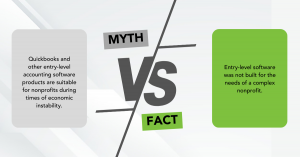
The 3 Most Compelling Reasons Nonprofits Should Consider Switching from QuickBooks

At JMT, we have worked with over 1,000 nonprofit organizations during the last 22 years to systematically evaluate their financial reporting and operational requirements and identify “best fit” solutions that will help them optimize their financial management systems and processes.  One of the key things we have learned during that time is that no two organizations [...]

Happy Birthday JMT!

Yesterday was a momentous day for JMT…it was our 22nd birthday! I know you would usually think of it as an anniversary, but for some reason I always think of it as a birthday rather than an anniversary as it really was the birth of JMT. And where I couldn’t care less about my own [...]

Bob Scott’s VAR Stars 2012 Announced

  Bob Scott’s VAR Stars 2012 Announced     JMT Consulting Group, Inc. has been selected as a member of the Bob Scott’s VAR Stars for 2012, a group of 100 organizations honored for their accomplishments in the field of midmarket financial software Members of the VAR Stars were selected based on factors such growth, [...]